Table of Contents
ToggleBuilding a deck doesn’t have to drain your savings account. With smart material choices and straightforward designs, homeowners can create a functional outdoor space that adds value and livability to their property, often for half the cost of a contractor’s typical bid. The key is understanding which design decisions actually matter for durability and which are just aesthetic upgrades that inflate the price tag. This guide walks through proven strategies for building a quality deck on a budget, from selecting cost-effective materials to choosing layouts that minimize waste and labor.
Key Takeaways
- Simple deck designs like rectangular ground-level decks cut material waste, labor hours, and foundation costs by 60-70% compared to complex multi-level designs.
- Pressure-treated wood is the most budget-friendly decking material at $2-4 per linear foot, while composite alternatives cost 2-3× more upfront but eliminate maintenance cycles for long-term savings.
- Floating deck platforms require no permits, ledger boards, or deep frost footings, making them the most cost-effective construction method for budget deck ideas.
- DIY rectangular decks with parallel board layouts maximize efficiency, requiring minimal cutting and reducing waste to nearly zero on standard lumber lengths.
- Buying lumber during off-season sales (March-April, September-October) saves 15-30%, and sourcing fasteners from specialty suppliers instead of big-box stores saves $40-70 per project.
- Opt for pressure-treated balusters over aluminum rails and skip railings entirely for ground-level decks to save $15-30 per linear foot on code-compliant construction.
Why Simple Deck Designs Save You Money
Complex deck designs with multiple levels, built-in planters, or intricate railing patterns drive up costs in three ways: more material waste from cuts, longer labor hours, and the need for additional fasteners and hardware.
A rectangular ground-level deck uses standard board lengths efficiently. When lumber comes in 8′, 10′, 12′, and 16′ lengths, a simple 12’×16′ deck means almost zero waste. Add curves, angles, or elevated sections, and the waste factor jumps to 15-20% of material costs.
Permitting costs also scale with complexity. Most jurisdictions allow ground-level decks under a certain square footage (often 200 sq ft) without a permit, as long as they’re not attached to the home’s structure. Once the design includes ledger boards bolted to the house or heights above 30 inches, building inspections and engineered plans become mandatory.
Foundation requirements simplify dramatically with ground-level builds. Elevated decks require frost footings, concrete piers extending below the frost line, which varies from 12 inches in southern states to 48+ inches in northern climates. Ground-level decks often need only compacted gravel and concrete deck blocks, cutting foundation costs by 60-70%.
Affordable Decking Materials That Look Great
Material selection represents 60-70% of a deck’s total budget. Choosing the right product for the project’s scope and the homeowner’s maintenance tolerance makes the difference between a smart investment and buyer’s remorse three years later.
Pressure-Treated Wood: The Budget-Friendly Classic
Pressure-treated southern yellow pine remains the most economical decking option in 2026, typically running $2-4 per linear foot for 5/4×6 deck boards (actual dimensions: 1″×5.5″). A 12’×16′ deck requires roughly 35 boards at 12′ length, totaling $840-1,680 just for decking material.
The treatment process forces preservatives deep into the wood fiber, protecting against rot and insects for 15-20 years with proper maintenance. Look for boards rated for ground contact (.40 retention level) even for deck surfaces, it’s minimal extra cost for significantly better longevity.
Key considerations for pressure-treated lumber:
• Moisture content matters. Newly treated boards contain 20-30% moisture. Let them dry 2-3 weeks before installation to minimize cupping and warping.
• Fastener compatibility. Use hot-dipped galvanized or stainless steel screws and joist hangers. Standard zinc-coated fasteners corrode when in contact with treated wood.
• Spacing for expansion. Leave 1/8″ gaps between boards. The wood will shrink as it dries, eventually creating the proper 3/16″ spacing for drainage.
• Annual maintenance. Plan to clean and reseal every 2-3 years. Without sealing, UV damage turns the wood silver-gray within 6-12 months.
Many homeowners appreciate budget DIY approaches that prioritize function over elaborate finishes, especially for first-time deck builders.
Composite Alternatives for Long-Term Savings
Composite decking costs 2-3× more upfront ($4-8 per linear foot) but eliminates the seal-and-stain cycle entirely. For homeowners planning to stay in their home 10+ years, the math often favors composite even though the higher initial investment.
Modern composite boards combine wood fiber and recycled plastic, offering several advantages:
• Zero rot or insect damage. The plastic encapsulation prevents moisture penetration.
• Minimal maintenance. Soap-and-water cleaning once or twice annually keeps the surface looking new.
• Consistent color. UV-resistant pigments prevent the fading common in early composite formulations.
• Hidden fastener systems. Grooved edges allow clips that attach from below, creating a fastener-free surface.
The catch: composite boards require specific framing. Maximum joist spacing drops from 16″ on-center (standard for wood) to 12″ on-center for most composite brands. That’s 33% more joists, adding $150-300 to framing costs on a typical 12’×16′ deck.
For budget builds, consider a hybrid approach: pressure-treated framing and joists with composite decking only. This captures most of the maintenance savings while keeping structural costs down.
Ground-Level Deck Designs That Cut Costs
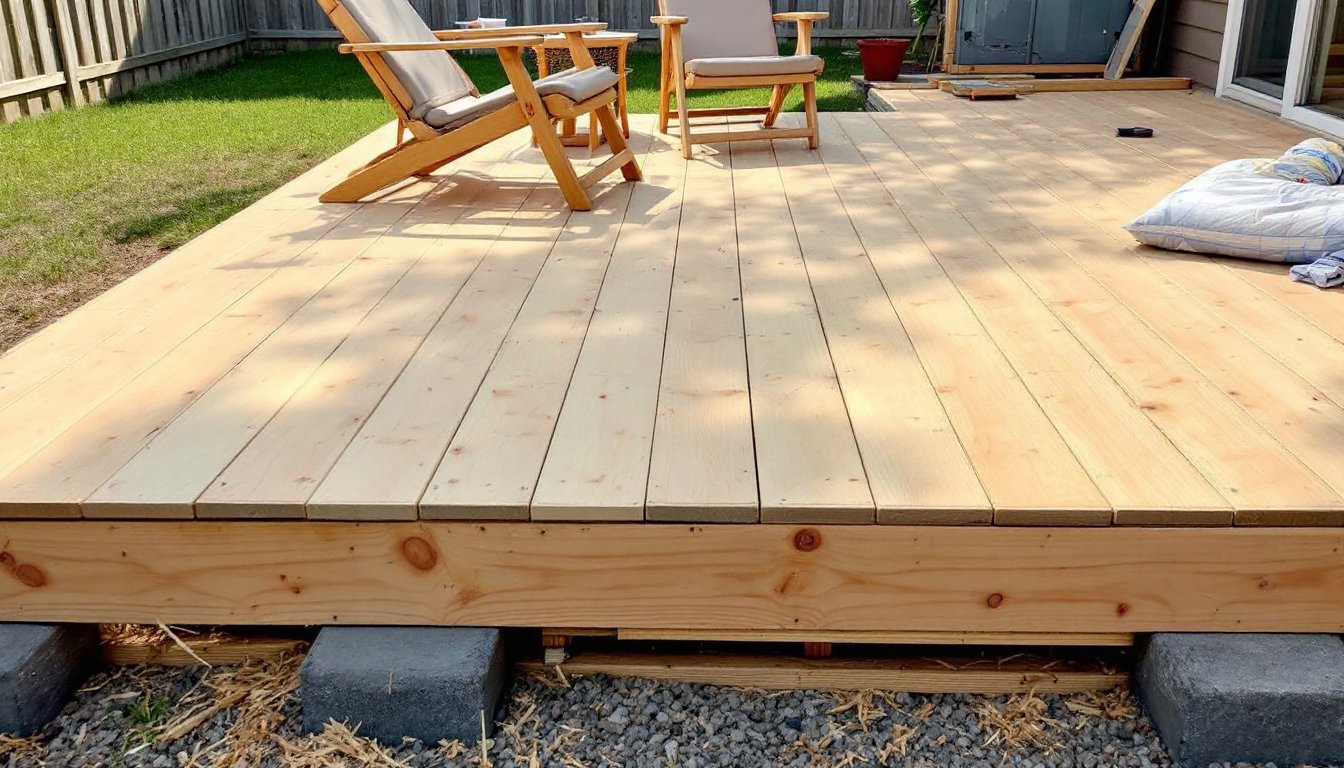
Floating decks, freestanding platforms not attached to the home, represent the simplest, most cost-effective design for flat yards. They eliminate the need for ledger boards, flashing, and the structural connections that trigger permit requirements in most jurisdictions.
Typical construction uses a perimeter beam frame of doubled-up 2×8 or 2×10 boards (actual: 1.5″×7.25″ or 1.5″×9.25″) supported by concrete deck blocks every 4-6 feet. These precast blocks cost $5-8 each and sit directly on compacted gravel, no digging required.
For a 12’×16′ floating deck:
• Perimeter framing: 56 linear feet of 2×8 treated lumber @ $0.70/ft = $40
• Interior joists: Nine 2×8×12′ joists @ $11 each = $99
• Deck blocks: 15 blocks @ $6 each = $90
• Decking: 35 boards of 5/4×6×12′ @ $24 each = $840
• Fasteners and hardware: $80-120
• Total material cost: $1,150-1,300
This assumes DIY labor. Hiring out for a simple ground-level deck typically adds $15-25 per square foot, or $2,880-4,800 for this 192 sq ft example.
Platform decks work especially well for sloped yards where one corner sits on grade while the opposite corner rises 12-18 inches. Rather than building the entire deck at the higher elevation (requiring tall posts and extensive footings), the platform design keeps most of the structure low with a single step-up transition.
One homeowner documented building a simple platform design using standard dimensional lumber, demonstrating how basic carpentry skills translate to outdoor projects.
DIY-Friendly Simple Deck Layouts
Rectangular decks with boards running parallel to the house maximize material efficiency and simplify installation. This orientation means most deck boards span from beam to beam without requiring butt joints or mid-span connections.
12’×12′ square decks hit a sweet spot for DIY builds. This size:
• Stays under the 144-200 sq ft permit threshold in many areas.
• Uses eight 2×8×12′ joists at 16″ on-center spacing (plus perimeter beams).
• Requires 26 deck boards at 12′ length with minimal cutting.
• Can be completed in 2-3 weekends by one person with basic carpentry skills.
For tools, a DIY deck build requires:
• Circular saw or miter saw (miter saw gives cleaner cuts but isn’t essential)
• Drill/driver with clutch for deck screws
• 4-foot level and string line for layout
• Post hole digger if installing footings (not needed for ground-level floating decks)
• Speed square and tape measure
• Safety gear: gloves, safety glasses, ear protection, and dust mask for cutting treated lumber
Diagonal decking patterns look impressive but waste 20-25% more material due to angle cuts. Every board needs mitered ends, and the perimeter requires constant measuring. Save diagonal layouts for future upgrades, they don’t improve structural performance or longevity.
Picture frame borders, perimeter boards running perpendicular to field boards, add visual interest without much extra complexity. Budget an additional $60-100 in materials and 3-4 hours of labor. The frame conceals end grain and creates a finished edge that covers any minor irregularities in field board lengths.
For homeowners tackling their first outdoor build, beginner-friendly approaches often emphasize simple patterns that build confidence before attempting more complex layouts.
Cost-Cutting Tips for Your Deck Project
Buy lumber in bulk during off-season sales. March-April and September-October offer 15-30% discounts at big-box stores as they clear seasonal inventory. Pressure-treated lumber stores indefinitely if kept dry and elevated off the ground.
Use structural-grade lumber only where it matters. Joists and beams require #2 grade or better for load-bearing capacity. Deck boards can use #3 or even “economy” grade, those knots and imperfections are on the surface where they don’t affect strength. Price difference: $3-6 per board.
Rent specialized tools rather than buying. A compound miter saw rents for $45-60 per day. Unless planning multiple projects, renting beats a $300-500 purchase. Same logic applies for post hole augers, laser levels, and pneumatic nailers.
Simplify railing or skip it entirely. Code requires railings for decks over 30″ above grade. Ground-level decks don’t need them, saving $15-30 per linear foot. For elevated decks, pressure-treated balusters cost half as much as aluminum or cable rail systems and meet the same IRC requirements (balusters no more than 4″ apart, rail height 36-42″).
Source fasteners from specialty suppliers, not big-box stores. A 5-lb box of #10×3″ deck screws runs $35-40 at home centers but $22-28 from online fastener retailers. For a full deck requiring 8-10 pounds of screws plus joist hangers and hardware, this saves $40-70.
Do your own site prep. Clearing vegetation, leveling the ground, and laying landscape fabric takes time but requires no special skills. Hiring this out typically costs $300-600 depending on lot conditions.
Consider a deck kit for material bundling. Some manufacturers offer pre-cut deck kits with all framing, decking, and hardware included. While not always cheaper, kits eliminate waste and the risk of ordering incorrect quantities. They’re worth comparing against a la carte material costs.
Finish end grain with deck sealant immediately. Every cut exposes untreated wood that will wick moisture. Brushing cut ends with copper naphthenate or similar preservative adds maybe $15 to project cost but prevents premature rot at connection points.
Material costs fluctuate regionally and seasonally. The prices cited here reflect national averages in early 2026 but can vary 20-40% based on local lumber market conditions, transportation costs to rural areas, and regional building code requirements.