Table of Contents
ToggleConcrete countertops have moved far beyond the cold, industrial aesthetic many homeowners remember. Today’s concrete surfaces offer remarkable design flexibility, from polished minimalism to textured farmhouse character, all while delivering durability that rivals natural stone. Whether you’re drawn to sleek monolithic slabs or custom-tinted surfaces that match your backsplash, concrete delivers on both form and function. This guide walks through the most compelling concrete countertop ideas shaping kitchens in 2026, plus the practical realities of installation and maintenance every homeowner should know before committing to this bold material choice.
Key Takeaways
- Concrete countertops offer superior customization, durability, and cost savings compared to premium natural stones, with professional installation ranging from $65–$135 per square foot.
- Polished concrete creates a sleek, contemporary look by grinding and exposing aggregate, but requires regular sealing every 1–3 years to prevent staining and etching.
- Textured and rustic concrete designs deliver farmhouse charm through wood-grain imprinting, salt finishing, and stone stamping techniques that echo organic materials at a fraction of the cost.
- Integral pigments and acid stains unlock custom color possibilities, from earthy tones to bold jewel tones, though lighter colors demand more vigilant maintenance and frequent resealing.
- Integrated concrete sinks and drainboards eliminate seams and create sculptural, leak-free features, but require food-safe epoxy sealing every 6–12 months to prevent water damage.
- DIY concrete countertops are achievable for advanced DIYers with carpentry skills, though precast or professional installation is recommended for complex layouts, integrated features, or first-time projects to ensure quality results.
Why Concrete Countertops Are Taking Over Modern Kitchens
Concrete countertops deliver three advantages that explain their growing popularity: customization, durability, and cost-effectiveness compared to premium natural stones.
Unlike granite or quartz slabs limited by quarry availability, concrete can be cast to any dimension, edge profile, or thickness. Need a 10-foot island without seams? Concrete handles it. Want an integrated backsplash or embedded trivets? The material accommodates design features that would require expensive fabrication in stone.
Properly sealed concrete resists heat up to 350°F, handles daily kitchen abuse, and ages gracefully when maintained. Expect a 1½-inch minimum thickness for adequate strength, though 2-inch slabs provide better structural integrity for spans over 24 inches without support.
Cost runs $65–$135 per square foot installed for professional work, competitive with mid-range granite but less than engineered quartz or exotic stones. DIY pours can cut material costs to $15–$30 per square foot, though the learning curve is steep.
The tradeoff: concrete requires ongoing maintenance. Plan to reseal every 1–3 years depending on sealer type and kitchen use. Skip this step and you’ll deal with staining, etching from acidic foods, and moisture penetration that can cause cracking.
Polished Concrete Countertops for a Sleek, Contemporary Look
Polished concrete delivers the refined, seamless aesthetic modern kitchens demand. The process involves grinding the cured surface with progressively finer diamond pads, starting at 50-grit and working up to 1500-grit or higher, then applying a densifier to harden the surface and bring out a glass-like sheen.
This finish exposes aggregate within the concrete mix, creating subtle visual texture. Specify pea gravel (⅜-inch) for delicate speckles or larger crushed glass for bolder patterns. The polishing process removes the top cement layer, revealing these embedded materials.
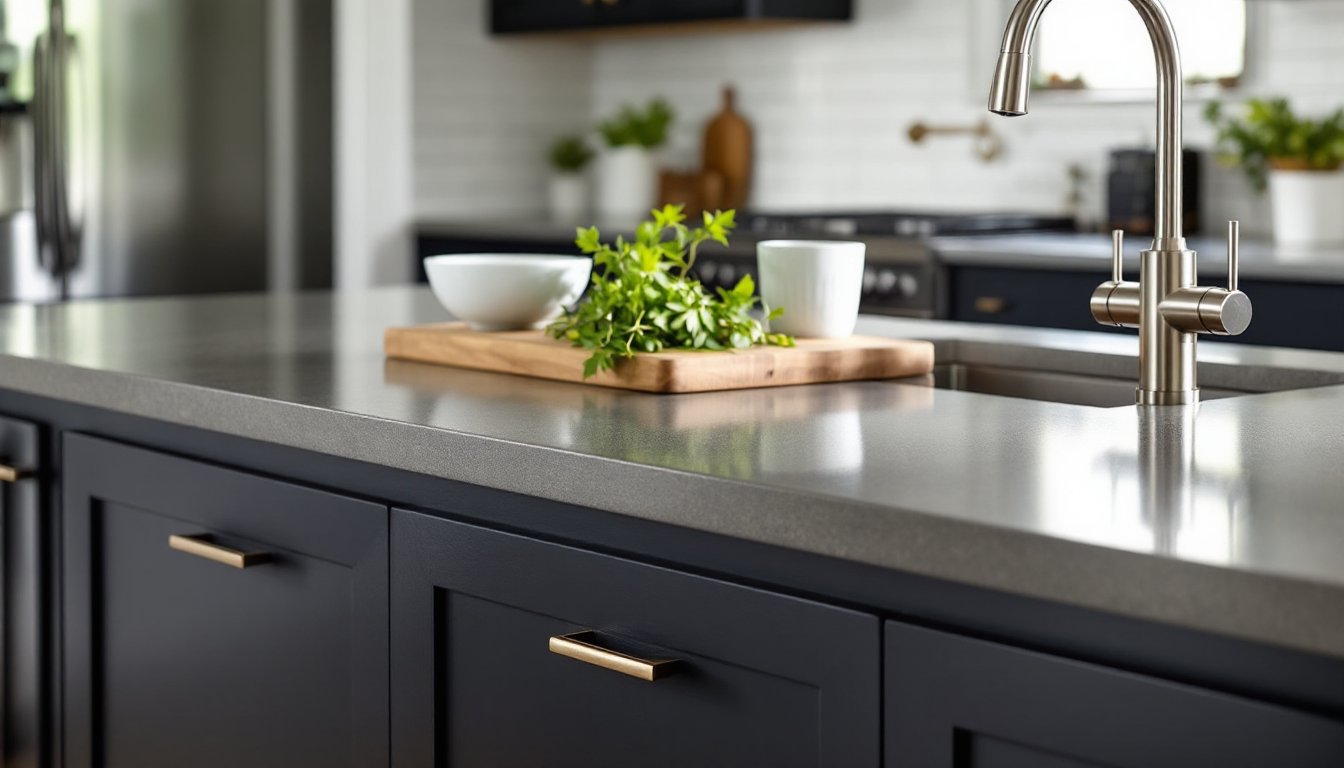
Paired with matte black cabinetry or white minimalist designs, polished concrete reads as sophisticated rather than industrial. The monolithic appearance, especially when edges are detailed with a simple square or slightly chamfered profile, reinforces clean lines.
Sealers matter here. Topical acrylic sealers add shine but scratch easily and require frequent recoating. Penetrating silicate or siliconate sealers preserve the polished look without a plastic film, though they offer less stain resistance. Many installers apply a penetrating sealer first, then a thin topical coat for balanced protection.
One caution: polished concrete shows fingerprints and water spots more readily than honed finishes. Keep microfiber cloths handy for quick wipe-downs, and avoid harsh cleaners that degrade sealers.
Textured and Rustic Concrete Designs for Farmhouse Charm
Textured concrete countertops bring warmth and character to farmhouse, cottage, and rustic kitchen styles. Instead of polishing the surface smooth, fabricators use trowels, brushes, or stamps to create deliberately imperfect finishes that echo hand-troweled plaster or aged stone.
Wood-grain texturing ranks among the most popular techniques. Installers press wooden planks into the wet concrete, then remove them after initial set to leave realistic grain impressions. This pairs beautifully with reclaimed wood shelving or shiplap backsplashes.
Salt finishing creates a subtly pitted surface. Coarse rock salt is pressed into the fresh concrete, then washed away after curing, leaving shallow depressions that catch light and add tactile interest. This technique works especially well on kitchen islands and breakfast bars where visual texture enhances the casual gathering space.
For deeper relief, stone stamps imitate flagstone, slate, or cobblestone patterns. The result reads less like traditional concrete and more like natural stone, though at a fraction of the cost.
Color matters with textured finishes. Earthy tones, warm grays, taupes, and buff shades, amplify the organic feel. Integral pigments mixed into the concrete provide consistent color throughout, while acid stains applied after curing create variegated, antiqued effects.
Sealing textured surfaces requires extra attention. The peaks and valleys trap dirt and moisture, so plan on more frequent cleaning and potentially more coats of sealer to ensure complete coverage.
Colorful Concrete: Adding Stains and Pigments for Custom Shades
Gray concrete is just the starting point. Integral pigments and acid stains unlock a spectrum of custom colors, from soft pastels to bold jewel tones.
Integral color pigments are mixed directly into the concrete before pouring. They provide uniform, fade-resistant color throughout the slab, critical if edges chip or the surface gets ground down during polishing. Oxide pigments (iron, chromium, cobalt) produce earthy reds, browns, yellows, greens, and blacks. Expect to add 2–10% pigment by weight of cement: more pigment intensifies color but can weaken the mix if overdone.
For subtle, variegated color, acid stains react chemically with the concrete after curing. The stain penetrates the surface and creates mottled, organic patterns, no two applications look identical. Earth tones dominate (terra cotta, amber, sage, charcoal), as the reaction depends on the mineral content of your specific concrete mix.
Water-based stains offer broader color options, including blues, purples, and bright greens, without the chemical reaction. They sit on the surface rather than penetrating deeply, so durability depends heavily on sealer quality.
For dramatic effect, combine techniques. Pour a base gray mix, then apply acid stain in a gradient from dark edges to lighter centers. Or embed colored glass aggregate, then polish to reveal bright flecks against a tinted background.
One constraint: pale colors show stains and wear more visibly than darker tones. Light blues and whites demand vigilant sealing and immediate cleanup of spills, especially from wine, coffee, or tomato-based foods.
Integrated Sinks and Drainboards: Seamless Concrete Features
Integrated concrete sinks and drainboards eliminate seams, reduce leak points, and create a sculptural, custom look impossible with drop-in fixtures.
Undermount sink molds are built into the form before pouring, creating a smooth transition from counter to basin. The sink can match the counter color exactly or contrast with different pigments. Radius corners (minimum 1-inch radius) prevent stress cracks and make cleaning easier than sharp 90-degree angles.
Integral drainboards, sloped sections with grooves directing water toward the sink, add old-world functionality. Cast the grooves directly into the surface, spacing them ½ inch apart and angling the entire section at a 2-3% slope. This detail requires careful form work and isn’t a beginner-friendly feature.
Plumbing considerations: concrete sinks need standard drain assemblies, but the weight requires solid support. A typical concrete sink adds 40–60 pounds to the countertop. Ensure cabinet framing includes blocking or corbels rated for the load, especially for farmhouse-style apron-front sinks that cantilever beyond the cabinet face.
Sealing integrated sinks is non-negotiable. Water exposure is constant, so apply food-safe epoxy or polyurethane sealers inside the basin rather than standard countertop sealers. Recoat every 6–12 months to prevent water absorption and staining. Many professionals discussing custom concrete casting techniques emphasize sink sealing as the most common maintenance failure point.
Alternative: use a stainless undermount sink for lower maintenance, reserving concrete for the counter surface only.
DIY Concrete Countertops: Is It a Project You Can Tackle?
DIY concrete countertops are achievable for experienced DIYers, but this isn’t a first-timer project. Expect a 2–3 week timeline from form building to final sealing, with significant physical labor and precision required.
Skill level: Advanced. You’ll need comfort with carpentry (building forms), mixing large batches of concrete consistently, and finishing techniques that determine final appearance. Mistakes are hard to reverse once concrete cures.
Two main methods:
-
Cast-in-place: Build forms directly on top of cabinets, pour, and finish on-site. Eliminates moving heavy slabs but limits access for polishing and detail work. Best for simple rectangular layouts.
-
Precast: Build forms in a workshop or garage, pour upside-down for a smooth finished surface, then cure, finish, seal, and install. Allows better quality control but requires moving 150–250 pounds per section, a two- or three-person job with appliance dollies or lifting straps.
Material costs run $15–$30 per square foot for a basic gray mix using 5000-PSI concrete, melamine-coated particleboard for forms, rebar or wire mesh reinforcement, and basic acrylic sealer. Add $5–$15/sq ft for pigments, decorative aggregates, or premium sealers.
Tools you’ll need:
- Circular saw or table saw for cutting form material
- Drill with mixing paddle attachment (½-inch chuck minimum)
- Angle grinder with diamond polishing pads if polishing
- Concrete vibrator or palm sander (for removing air bubbles)
- Random orbital sander for finish work
- PPE: Respirator (concrete dust contains silica), safety glasses, chemical-resistant gloves
Challenges that trip up DIYers: achieving consistent color across batches, eliminating air voids (bug holes) on visible surfaces, preventing cracks during cure, and applying sealers evenly without streaks. Expect your first project to have minor imperfections, consider those part of the character.
When to hire a pro: complex layouts with seams, integrated sinks, decorative inlays, or if you lack workspace for precasting. Professional installation with design guidance from remodeling resources costs more upfront but delivers finished results immediately and often includes warranty coverage.
Permits: Countertops are typically cosmetic and don’t require permits unless you’re altering plumbing or load-bearing structures during the install.
Conclusion
Concrete countertops offer design flexibility that few materials match, from mirror-polished minimalism to textured farmhouse character. Whether you’re drawn to the seamless look of integrated sinks or the custom color possibilities of stained finishes, concrete delivers both visual impact and long-term durability when properly sealed and maintained. DIY installation is within reach for skilled hands, though professional fabrication remains the smarter choice for complex designs or first-time installations. Weigh the maintenance commitment against your lifestyle, concrete rewards care but won’t forgive neglect.