Table of Contents
ToggleChoosing the right flooring for a home office isn’t just about aesthetics, it affects comfort during long work sessions, acoustics during video calls, and even how easily an office chair rolls across the surface. The wrong choice can mean daily frustration with tangled chair wheels, cold feet in winter, or echoing audio that makes virtual meetings unbearable. The right flooring supports productivity, withstands the unique wear patterns of a workspace, and complements the room’s design without breaking the budget or requiring professional installation.
Key Takeaways
- Home office flooring ideas must balance comfort, acoustics, and durability to support productivity during long work sessions and video calls.
- Hardwood and bamboo provide classic aesthetics and long-term value, while luxury vinyl plank (LVP) and laminate offer budget-friendly alternatives with superior water resistance.
- Carpet and cork flooring excel at sound absorption and ergonomic support, making them ideal for recording content or standing-desk users who need acoustic control.
- Match chair caster material to your flooring type—hard casters damage soft floors while soft rubber casters protect hard surfaces, or use a chair mat to extend floor longevity.
- Floating-floor options like LVP, laminate, and engineered hardwood are DIY-friendly with proper subfloor prep, while solid hardwood and carpet installation typically require professional help.
- Consider maintenance costs over 10-15 years, not just initial price—hardwood needs periodic refinishing, while LVP requires only damp mopping and carpet demands regular vacuuming.
Why Your Flooring Choice Matters for Productivity and Comfort
A home office floor endures concentrated traffic patterns, rolling chairs track back and forth over the same paths, desk legs create pressure points, and dropped equipment can cause impact damage. Unlike living spaces where foot traffic spreads across the room, office floors bear repeated stress in narrow zones.
Ergonomic considerations play a bigger role than most homeowners realize. Hard surfaces like tile or concrete can cause leg fatigue during long standing-desk sessions, while overly soft carpet makes chair movement difficult and forces users to push harder with each roll. The sweet spot depends on whether someone sits or stands most of the day.
Acoustic properties matter for anyone taking calls or recording content. Hard surfaces reflect sound, creating echo that cheapens audio quality and makes voices harder to understand. Softer materials absorb sound waves, reducing reverb and background noise, critical for professional-quality communication.
Maintenance requirements affect long-term satisfaction. Coffee spills, ink marks, and general wear happen more frequently in a workspace than a bedroom. Some materials clean easily with a damp mop: others stain permanently or require specialized products. Factor in the time and cost of upkeep over 10-15 years, not just the initial installation price.
Hardwood Flooring: Timeless Elegance for Professional Spaces
Solid hardwood delivers the premium look that clients and colleagues notice on video calls. Oak, maple, and walnut offer durability measured in decades, with the ability to sand and refinish multiple times. Expect to pay $6-12 per square foot for materials plus $3-5 per square foot for professional installation, though costs vary significantly by region and wood species.
Hardwood handles chair casters well once properly finished, polyurethane or hard-wax oil creates a protective barrier against rolling wear. Choosing traditional hardwood flooring for high-traffic areas requires finish selection that balances durability with appearance. Use a chair mat under rolling chairs to extend the floor’s life, especially with harder caster materials.
Engineered hardwood offers similar aesthetics at lower cost ($3-8 per square foot) and better dimensional stability in rooms with humidity fluctuations. The plywood or HDF core resists expansion and contraction better than solid wood, making it suitable for basements or rooms above crawl spaces. The trade-off: thinner wear layers limit how many times it can be refinished, usually once or twice versus five to seven times for solid hardwood.
Installation difficulty varies. Solid hardwood typically requires professional installation, especially for nail-down applications over subfloor. Many engineered products feature click-lock systems that determined DIYers can handle with a miter saw, pull bar, and tapping block. Acclimate all wood flooring in the room for 72 hours before installation to prevent gapping or buckling.
Laminate and Vinyl Plank: Budget-Friendly Alternatives with Style
Luxury vinyl plank (LVP) mimics hardwood appearance at $2-7 per square foot while offering superior water resistance. The photographic wear layer over vinyl core creates realistic wood grain that survives spills without warping, a major advantage over real wood if the office shares space with a bathroom or kitchenette. LVP installs as a floating floor with click-lock edges, making it one of the most DIY-friendly options.
Look for products with wear layer thickness of at least 12 mil (0.3mm) for office use. Thinner layers scratch more easily under chair casters and foot traffic. Commercial-grade LVP at 20-30 mil costs more but handles rolling chairs without a mat. Some premium lines include attached underlayment with sound-dampening properties.
Laminate flooring costs slightly less ($1-5 per square foot) but can’t tolerate moisture like LVP. The fiberboard core swells permanently if water seeps into joints, making it poor for rooms with spill risk. Where it excels: abrasion resistance. Quality laminate with AC4 or AC5 ratings handles heavy traffic and rolling loads better than many hardwoods.
Both materials install similarly using the floating floor method, no nails, staples, or glue to the subfloor. The entire floor rests on thin foam underlayment and interlocks at the seams. A pull bar, tapping block, and utility knife handle most installations. Many people exploring creative workspace solutions choose these materials for their combination of appearance, durability, and manageable installation.
Subfloor prep matters more than many DIYers expect. The surface must be flat within 3/16″ over 10 feet. High spots cause planks to rock and eventually damage the locking mechanism: low spots create hollow sounds and weak points. Use floor leveling compound or sand down bumps before laying underlayment.
Carpet and Area Rugs: Softness and Sound Absorption Benefits
Low-pile carpet in nylon or polyester provides comfort underfoot while offering better chair mobility than plush or shag styles. Loop or cut-and-loop construction at pile heights under 1/2″ works best for office use. Denser carpet (higher face weight, typically 40+ ounces per square yard) resists crushing under chair legs and foot traffic better than lighter options.
Carpet excels at sound control, it absorbs footstep noise, reduces echo during calls, and dampens sound transmission to rooms below. For anyone recording videos or podcasts, carpet solves acoustic issues that would otherwise require wall panels or foam treatment. The downside: it traps dust, pet hair, and allergens more than hard surfaces. Regular vacuuming becomes non-negotiable.
Carpet tiles (12″x12″ or 18″x18″ squares) offer a middle ground. They install without tack strips or professional stretching, most feature peel-and-stick backing or interlocking edges. If one tile stains or wears, replace just that section rather than the entire floor. Commercial carpet tile runs $2-5 per square foot and handles office wear exceptionally well.
Use a chair mat over carpet to reduce rolling resistance and prevent premature crushing. Polycarbonate mats last longer than vinyl and don’t crack in cold temperatures. For pile heights above 3/8″, choose mats with cleats on the bottom to grip the carpet.
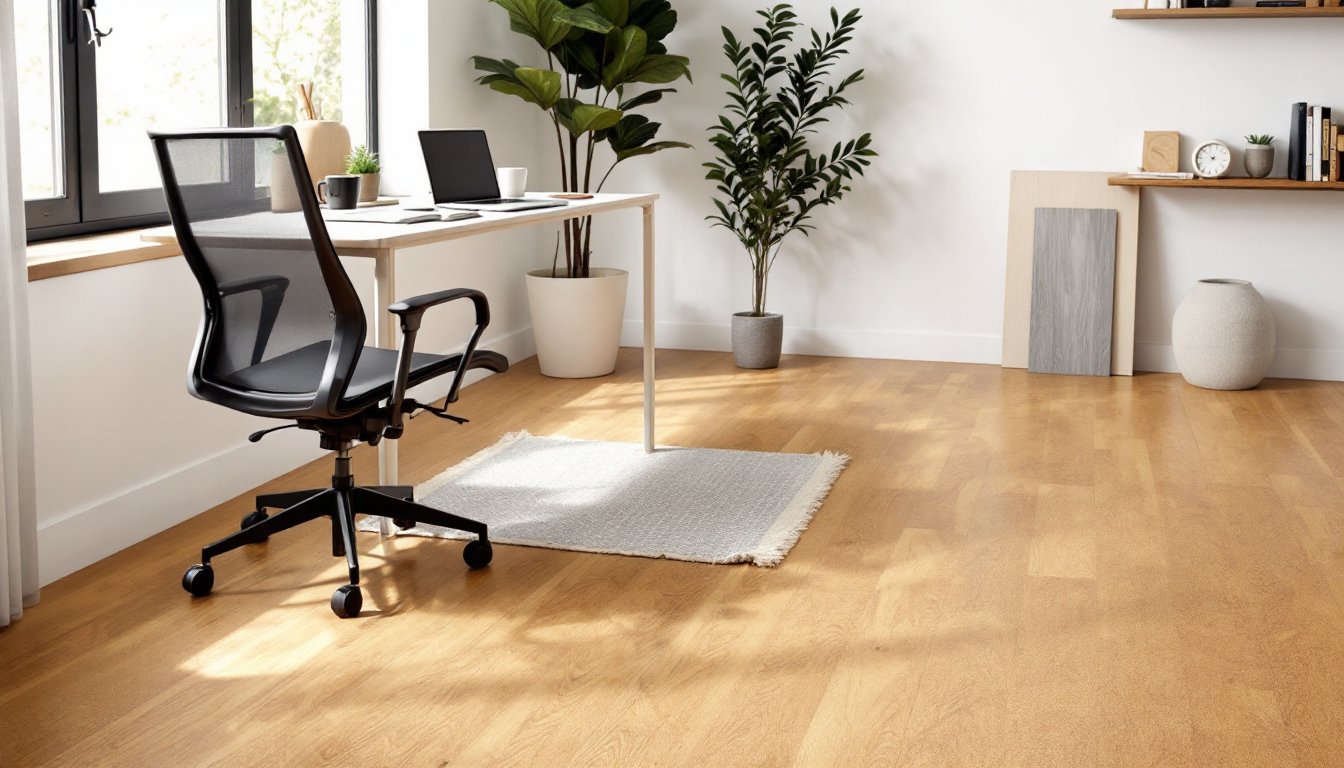
Area rugs over hard flooring combine both worlds, acoustic absorption where needed, easy cleaning around the perimeter. A 5’x7′ or 8’x10′ rug under the desk zone adds warmth and sound dampening without covering the entire floor. Rug pads prevent slipping and protect the floor underneath. This approach works especially well in rooms integrating elements from various home decor concepts.
Cork and Bamboo: Eco-Friendly Options for Sustainable Homes
Cork flooring offers unique ergonomic benefits, its natural cushioning reduces leg and back fatigue during long work sessions. The cellular structure compresses slightly underfoot, similar to a yoga mat, making it comfortable for standing-desk users. Cork also provides natural thermal insulation, keeping floors warmer in winter without radiant heating.
Cork’s acoustic properties rival carpet for sound absorption. The honeycomb structure traps sound waves, reducing echo and creating a quieter workspace. It’s naturally antimicrobial and hypoallergenic, resisting mold and mildew better than carpet or wood.
Expect to pay $3-8 per square foot for cork tiles or planks. Installation methods vary, glue-down tiles require more skill, while floating-floor planks with click-lock systems suit DIY installation. Cork scratches and dents more easily than hardwood, so using a chair mat isn’t optional, it’s necessary. Apply polyurethane sealer every few years to maintain water resistance.
Bamboo flooring provides hardwood aesthetics from a rapidly renewable grass that matures in 3-5 years versus 30+ for oak. Strand-woven bamboo (compressed bamboo fibers) ranks harder than most domestic hardwoods on the Janka scale, making it suitable for high-traffic areas. Costs run $3-8 per square foot, similar to mid-grade hardwood.
Bamboo installs like hardwood, nail-down, glue-down, or floating methods depending on the product. It handles chair casters well but shares hardwood’s sensitivity to moisture and humidity. Avoid bamboo in basements or rooms with poor climate control. Some homeowners incorporating sustainable design principles appreciate bamboo’s lower environmental impact compared to traditional lumber.
Both materials require acclimation before installation, 72 hours minimum in the room at normal temperature and humidity. Skipping this step leads to gapping or buckling as the material adjusts to local conditions post-installation.
Practical Considerations: Durability, Maintenance, and Chair Mobility
Chair caster type affects flooring longevity more than most people realize. Hard plastic casters damage soft floors (wood, vinyl, cork): soft rubber or polyurethane casters protect hard floors but collect debris that scratches. Match caster material to flooring type, or use a chair mat regardless of surface.
Rolling resistance varies dramatically by material. Hard surfaces allow effortless chair movement: thick carpet requires constant pushing that causes fatigue. Test chair mobility before committing to carpet in a workspace where someone moves frequently between desk zones, printers, or filing areas.
Maintenance realities shape long-term satisfaction. Hardwood requires periodic refinishing ($1.50-3 per square foot every 7-10 years). LVP and laminate need only damp mopping but can’t be refinished, once the wear layer fails, replacement is the only option. Carpet demands weekly vacuuming and professional steam cleaning annually. Resources on maintaining living spaces can provide additional practical guidance.
Consider the room’s subfloor and underlayment. Concrete slabs need moisture barriers before installing wood or laminate. Plywood subfloors over joists benefit from additional underlayment to reduce sound transmission and cushion flooring. Some floating floors include pre-attached underlayment: others require separate installation.
DIY installation saves $2-5 per square foot in labor but requires honesty about skill level. Floating floors (LVP, laminate, some engineered hardwood) suit confident DIYers with basic tools. Hardwood nail-down, carpet stretching, and tile work typically warrant professional help unless someone has prior experience. Improper installation voids most warranties.
Resale value considerations matter for permanent flooring choices. Hardwood adds more perceived value than laminate or carpet, though quality LVP has gained acceptance. Unusual choices like cork or bright-colored carpet may appeal to current tastes but limit future buyer interest. Projects documented in transformation guides show how thoughtful material selection affects overall room appeal.
Conclusion
The ideal home office flooring balances comfort, functionality, and budget while accommodating the unique demands of a workspace. Hardwood and bamboo offer long-term durability and classic aesthetics: LVP and laminate provide practical, cost-effective alternatives: carpet and cork deliver ergonomic and acoustic benefits. Success comes from matching material properties to actual usage patterns, how the space is used daily matters more than abstract design preferences.