Table of Contents
ToggleThe deck board pattern you choose does more than cover your frame, it defines the visual flow of your entire outdoor space. Whether you’re replacing worn decking or building from scratch, the layout impacts material waste, installation time, and long-term performance. A well-planned pattern can make a small deck feel larger, guide foot traffic naturally, or create distinct zones for dining and lounging. This guide walks through proven deck patterns, from timeless classics to modern designs, with straight talk about what each layout demands in terms of skill, materials, and structural support.
Key Takeaways
- Deck board patterns directly impact structural integrity, water drainage, seasonal expansion, and long-term performance—making layout choice as important as material selection.
- Straight parallel decking is the most beginner-friendly deck pattern, requiring standard 16-inch joist spacing and minimal cuts, while diagonal and herringbone patterns demand tighter 12-inch spacing and professional-grade tools.
- Material waste ranges from 10% for straight patterns to 25-30% for herringbone and chevron designs, so budgeting 15-20% extra material is essential for complex layouts.
- Diagonal and herringbone deck patterns create visual interest and can make irregular shapes appear more finished, but require extensive blocking at board transitions to meet building codes.
- Your skill level should drive pattern selection—beginners should choose straight runs, intermediates can handle picture frames or inlays, and only experienced carpenters should tackle herringbone or chevron without professional help.
- Modern deck patterns using mixed widths, contrasting inlays, or hidden fasteners offer contemporary aesthetics without the structural complexity of traditional geometric patterns like herringbone.
Why Deck Board Patterns Matter for Your Outdoor Space
Deck board patterns aren’t just decorative, they directly affect structural integrity and longevity. The direction and layout of your boards determine how water drains, where debris collects, and how much the deck expands and contracts with seasonal temperature swings.
Structural considerations come first. Any pattern beyond simple parallel boards requires additional blocking or modified joist spacing. Diagonal decking needs joists spaced closer together (typically 12 inches on center instead of 16) to prevent bounce. Picture-frame borders and complex patterns like herringbone demand solid blocking at every transition point where board ends meet.
Visual impact matters, too. Running boards parallel to the house tends to make narrow decks look wider, while diagonal patterns draw the eye outward and can disguise irregular shapes. Patterns with multiple directions break up large expanses and create natural zones without railings or furniture.
Material waste varies significantly by pattern. Straight runs waste roughly 5-10% of material to trim and defects. Diagonal layouts bump that to 15-20%. Herringbone and chevron patterns can hit 25-30% waste due to angled cuts and short remnants. Budget accordingly.
Maintenance needs shift with pattern complexity. More seams mean more places for moisture to penetrate and more end grain to seal. Composite decking minimizes this issue, but with wood decking, intricate patterns require more frequent staining and inspection for rot at connection points.
Classic Deck Patterns That Never Go Out of Style
Straight and Diagonal Decking
Straight parallel decking remains the most common pattern for good reason: it’s fast, efficient, and structurally straightforward. Boards run perpendicular to the joists with standard 16-inch on-center joist spacing. Fasteners go directly into each joist, and most DIYers can complete installation without specialized cuts.
For a subtle upgrade, add a picture-frame border, a perimeter of boards running opposite the field direction. This hides end grain and gives a finished look, but requires blocking between joists wherever the border boards run parallel to them. Use the same decking material for the border to avoid color-matching issues as both sections weather.
Diagonal decking (typically at 45 degrees) adds visual interest and works especially well on decks that aren’t perfect rectangles. The angled lines camouflage slight irregularities in shape. But, you’ll need to tighten joist spacing to 12 inches on center to meet most building codes and prevent springy boards.
Diagonal installations require more planning. Start your layout from the most visible corner and work outward. Every board end needs solid bearing on a joist, which means more cuts and more blocking. A miter saw or sliding compound miter saw is nearly essential, trying to freehand 45-degree cuts with a circular saw leads to gaps and frustration.
Both patterns work with any decking material, from pressure-treated southern yellow pine to composite boards. Just follow the manufacturer’s fastening requirements, as some composite products need specific gap spacing for thermal expansion.
Herringbone and Chevron Patterns
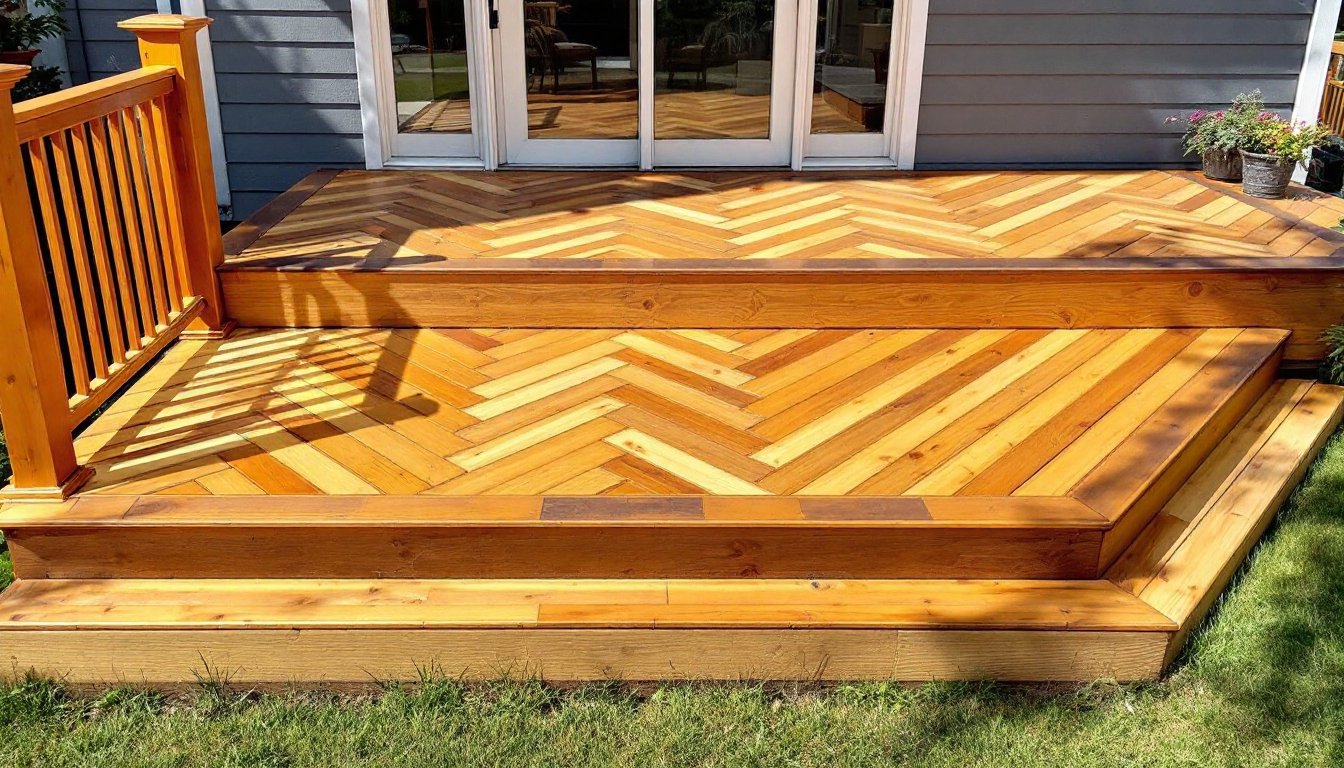
Herringbone and chevron patterns create a premium, high-end look that’s unmistakable. Both use boards set at angles to form a zigzag pattern, but they differ in construction. Herringbone boards meet at their ends in a staggered, offset pattern. Chevron boards are cut at precise angles so they meet point-to-point in a continuous V.
These patterns require significant structural modifications. You’ll need a grid of blocking between joists, essentially creating a secondary support framework. Every single board end must land on solid wood, which means blocking at 16-inch or 12-inch intervals depending on your joist spacing and board span ratings.
Installation difficulty jumps considerably. Chevron demands highly accurate miter cuts (usually 45 degrees) on every board end. A single degree of error compounds across the pattern, creating visible misalignment. Herringbone is slightly more forgiving since the ends don’t have to align perfectly, but it still requires careful measuring and cutting.
Material waste hits 25-30% for these patterns. You’re making two angled cuts on many boards, and short leftover pieces often can’t be used elsewhere. Order extra and plan your cuts to minimize waste, working from full-length boards and using cutoffs strategically can reduce costs.
Both patterns look stunning with natural wood species like ipe or tigerwood, where the grain direction creates additional visual texture. Some homeowners also appreciate options like interlocking wood tiles for smaller deck areas. Consider a professional installation if you haven’t done complex cuts before: labor costs are high, but so is the cost of wasted premium decking material.
Modern Deck Pattern Ideas for Contemporary Homes
Contemporary deck designs often mix board widths, colors, or orientations to create geometric interest without traditional pattern complexity. Contrasting inlays use a different decking color or material to create borders, stripes, or rectangular accents within the main field. Composite decking makes this easier, many manufacturers offer matching trim boards in coordinating colors.
A parquet-style pattern arranges square or rectangular sections of decking in alternating orientations, similar to parquet flooring. Each section might be 3×3 feet or 4×4 feet, with boards in one square running north-south and the adjacent square running east-west. This requires extensive blocking but creates a modern, architectural look that works well on large, minimalist decks.
Vertical board accents integrated into horizontal decking add dimensional depth. Install a few boards on edge (face-up rather than flat) to create narrow raised stripes. This works best with thicker decking materials (2-inch nominal thickness or specialty vertical-grain boards) and needs custom blocking to support the different orientation.
Mixed-width planking uses boards of varying widths, say, alternating between 4-inch and 6-inch face widths, to break up uniformity. Some composite manufacturers now offer multi-width kits designed for this purpose. The key is maintaining consistent gaps for drainage and expansion while working with different board widths.
For a truly contemporary look, consider deck boards with hidden fasteners or grooved edge boards that create seamless surfaces without visible screws. These systems add cost but deliver the clean lines modern architecture demands. Many outdoor living features popular in western design trends emphasize these minimalist details.
Whichever modern pattern you choose, mock it up first. Use painter’s tape or chalk lines on your existing deck or subfloor to visualize the layout at full scale before committing to materials and blocking.
Choosing the Right Deck Pattern for Your Budget and Skill Level
Skill level should drive your pattern choice as much as aesthetics. If this is your first deck project, stick with straight parallel boards or a simple diagonal layout. Both are forgiving and don’t require precision joinery. You can complete a 12×16-foot deck in a weekend with basic tools: circular saw, drill, speed square, and chalk line.
Intermediate DIYers with some trim carpentry experience can tackle picture-frame borders and simple inlay patterns. You’ll need a miter saw for accurate angle cuts and comfort with blocking installation. Expect to spend an additional day on layout and blocking compared to a straight-run deck.
Advanced patterns, herringbone, chevron, parquet, or multi-directional designs, demand experienced carpentry skills. If you can’t confidently cut compound miters or don’t own a quality miter saw, hire a pro or choose a simpler pattern. The labor cost difference between a straight deck and a herringbone deck can be $3-$5 per square foot or more.
Budget impacts go beyond labor. Here’s a realistic breakdown for a 300-square-foot deck using mid-grade materials:
- Straight pattern: 10% waste, ~$1,800-$2,400 in decking materials
- Diagonal pattern: 18% waste, ~$2,100-$2,800
- Herringbone pattern: 28% waste, ~$2,500-$3,300
Those figures assume $6-$8 per square foot for materials and include fasteners and blocking. Premium hardwoods or high-end composites can double those costs. Many ideas seen in southern outdoor living spaces balance pattern complexity with material costs by using simpler layouts with quality materials.
Structural modifications add expense, too. Closer joist spacing means more lumber and more labor. Blocking for complex patterns adds another $150-$300 in framing lumber for a typical deck.
Permits generally aren’t affected by pattern choice, they’re based on deck size, height, and attachment to the structure, but inspectors will check that your joist spacing and blocking meet code for your chosen layout. Check local requirements before finalizing your design.
Conclusion
Choosing a deck pattern means balancing visual impact with structural requirements, budget realities, and honest assessment of your carpentry skills. Straight and diagonal patterns deliver solid performance and good looks without testing your patience. Herringbone and chevron make bold statements but demand precision and material investment. Modern mixed-direction layouts offer a middle ground, distinctive without being overly complex. Plan your blocking, account for waste, and choose a pattern that matches both your vision and your weekend availability.